Hunger Heroes: How Manchester South Central Food Bank Is Supporting Families
Project Manager Heidi shares how her small team is responding to growing demand — and why partnerships like Bankuet are vital.
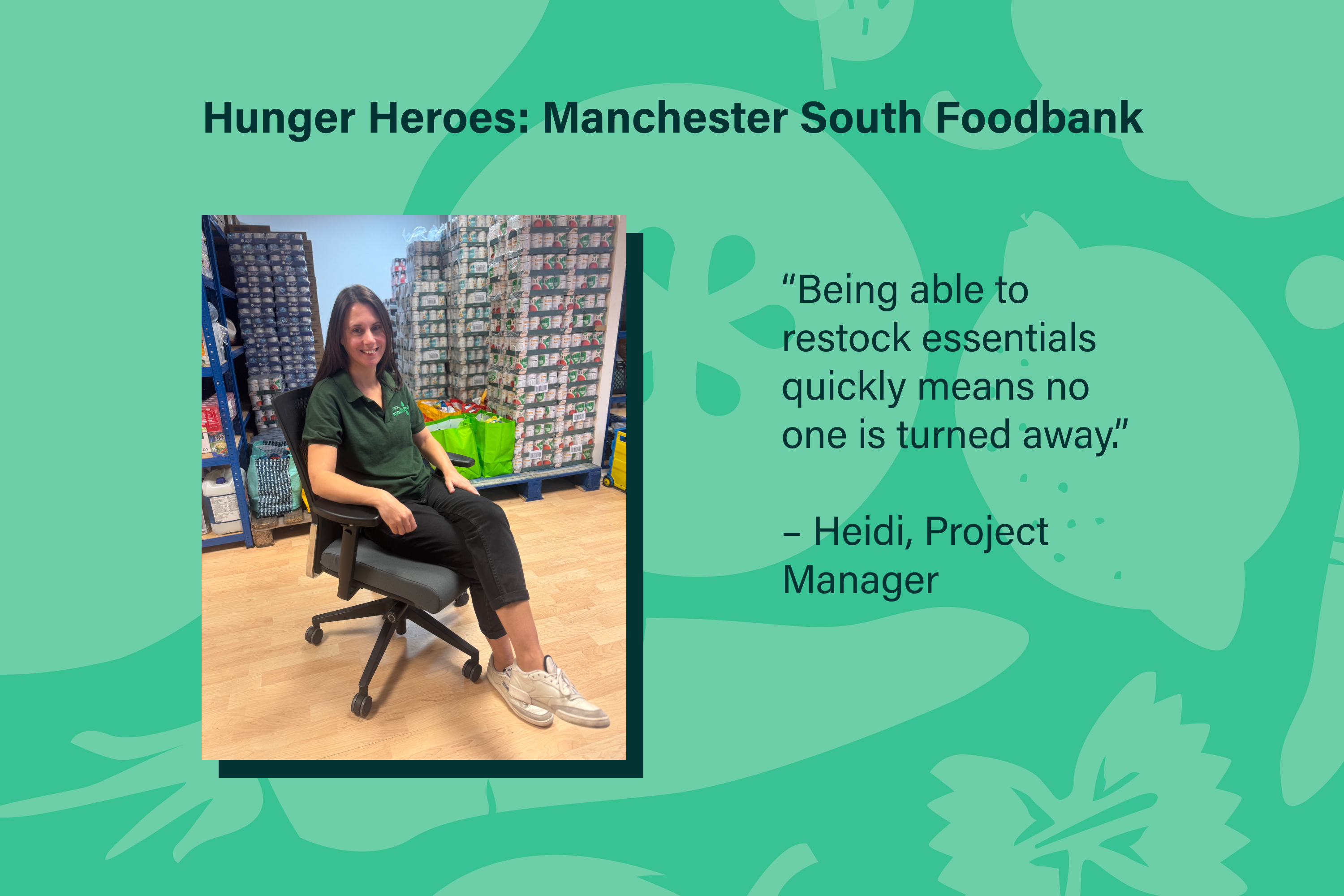
Manchester South Central Food Bank is working at the sharp edge of rising need, shrinking donations, and widening inequality. Project Manager Heidi shares how her small team is responding to growing demand — and why partnerships like Bankuet are vital in ensuring no one is turned away.
A grassroots food bank at the heart of the community
“We’re a small, grassroots charity,” says Heidi, Project Manager at Manchester South Central Food Bank. “There are just two and a half paid staff, supported by around 30 volunteers, running three food bank sessions a week.”
Based just 15 minutes from Manchester city centre, the food bank serves Hulme, Moss Side, Whalley Range, and Old Trafford — some of the most deprived wards in the city.
“These are communities with long-standing inequality,” Heidi explains. “We work closely with local schools, support groups, and community organisations to make sure families don’t fall through the cracks.”
Rising demand, falling donations
Like many food banks across the UK, Manchester South Central is seeing demand rise sharply — while traditional donations decline.
“Our biggest challenge right now is simply making sure we can support everyone who comes through our doors,” Heidi says. “Demand is going up, but physical donations are going down.”
Changes in how people shop have had a big impact. “More people now shop online, which means fewer donations in supermarket collection points. At the same time, household budgets are stretched, so people can’t always give as much.”
As a result, the team has had to adapt quickly. “We’ve had to build new fundraising skills and diversify how people can support us, so that nobody gets turned away.”
Winter pressure and the Christmas surge
Winter is always the toughest time of year — and Christmas adds extra strain.
“As the weather gets colder, energy bills rise, and families are forced to make impossible choices between heating and eating,” Heidi explains. “Christmas is our busiest period, and we’re already preparing for a big surge in demand.”
The food bank’s biggest concern is making sure shelves are stocked ahead of that peak. “We want to be ready — with food, toiletries, and the resources people need — so we can support families through the hardest months.”
Who the food bank supports
There’s no single profile of someone using the food bank.
“We see working families, people in insecure employment, people affected by illness, and those dealing with delays in welfare support,” Heidi says. “Many people aren’t facing a short-term crisis anymore — they’re stuck in longer-term hardship.”
The cost-of-living crisis, alongside slower health and welfare systems, has meant people need ongoing support rather than a one-off food parcel.
Beyond food: addressing wider needs
Food is only part of the picture.
“One of the biggest issues we saw during COVID was the digital divide,” Heidi explains. “Some families had no internet access at all, which meant children couldn’t learn at home and adults couldn’t access essential services.”
In response, the food bank now provides free SIM cards and supports families with access to laptops. “Digital access is no longer a luxury — it’s an essential.”
How Bankuet helps fill the gaps
For a small team, Bankuet has become an essential part of the operation.
“We don’t have the capacity to build our own online donation systems,” Heidi says. “Partnering with Bankuet gives people a simple way to donate — and gives us a reliable way to get food when we need it.”
When shelves start running low, the impact is immediate. “I can log into our Bankuet account, place an order, and within a couple of days the food is back on the shelves, ready to go out to clients.”
The new ordering system has made things even easier. “I can see exactly what we need, order precise quantities, and have it delivered straight to us. It’s incredibly efficient.”
What’s needed (and what’s not)
Every food parcel is carefully packed to cover breakfast, lunch, and dinner, alongside essentials like toiletries.
“The items we most need are milk, tea bags, jam, tinned fruit, and toiletries,” Heidi explains. “Toiletries are often overlooked, but they’re expensive and just as essential as food.”
Some items arrive in abundance. “We receive a lot of pasta and rice, which we do need — just not always in such high quantities.”
Looking at the past year, the most requested Bankuet items were biscuits, spaghetti hoops, baked beans, tinned tuna, and mandarins.
“People are often surprised to see baked beans on that list,” Heidi says. “But we provide holiday hunger bags during school holidays, and those items are really popular with families when free school meals aren’t available.”
Why continued support matters
Despite the challenges, Heidi is clear about what keeps the food bank going.
“This service is here to stay for now,” she says. “Demand is increasing, donations are decreasing, and communities still need us.”
Regular donations make a huge difference. “Whether it’s a one-off gift or a monthly donation through Bankuet, that support helps us plan ahead and make sure nobody is turned away.”
How you can help
One of the easiest ways to support Manchester South Central Food Bank is by donating through Bankuet. Your donation is turned directly into the food and essentials the food bank needs most — exactly when they need them.
“Bankuet allows us to respond quickly and flexibly,” Heidi says. “It’s an incredible partnership, and we’re so grateful to everyone who donates.”


