Hunger Heroes: How Bestwood & Bulwell Food Bank is Feeding Nottingham’s Poorest Communities
Project Manager Nigel Webster shares how his team is tackling rising needs, building resilience, and helping people rebuild.
A response rooted in community
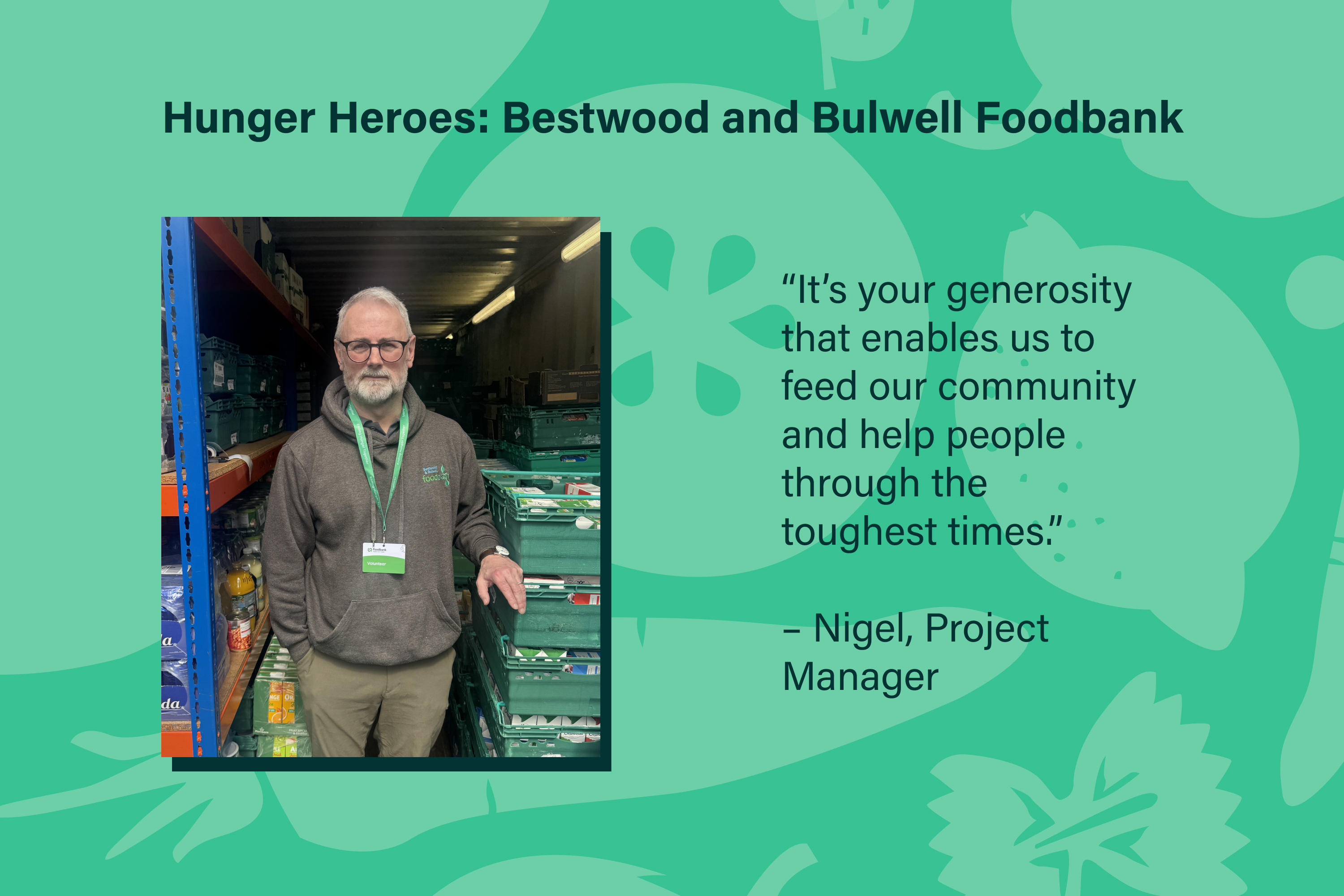
“My name’s Nigel Webster, and I’m the Project Manager at Bestwood & Bulwell Food Bank, one of the busiest food banks in north Nottingham,” Nigel begins. “We’ve been going for 13 years, originally set up by local churches who wanted to respond to the real needs in our area.”
Those needs were, and still are, severe. “We’re based in one of the most deprived areas in England,” Nigel explains. “There are very low incomes, high levels of personal debt, and deep, long-term poverty. The churches came together to ask: ‘What can we do?’ Running a food bank was one clear, practical answer.”
A growing need
“When we first started, we helped just a few families,” Nigel recalls. “But numbers grew fast — especially during COVID and the cost-of-living crisis. Even now, we’re feeding 50% more children under 16 than the average Trussell Trust food bank.”
The people they support reflect the surrounding community. “We help young and old, working and unemployed. Some have lost jobs, others face impossible choices between heating and eating. Rising energy costs hit everyone, but for people on low incomes, it’s devastating.”
Beyond food: helping people rebuild
While food is the starting point, the support goes much deeper.
“Giving someone a food parcel is only the beginning,” says Nigel. “We also have debt advisors and support workers who help people access benefits, grants, or mental health services.
It’s about helping people get their lives back on track, not just meeting immediate needs. We want to end the need for food banks in the long run.”
How Bankuet fills the gaps
Like many food banks, Bestwood & Bulwell relies on public donations — often one tin at a time from schools, churches, and individuals. But when shelves run bare, Bankuet helps fill the gaps.
“Bankuet gives us an easy and efficient way to purchase bulk food,” Nigel explains. “We can order exactly what we need, when we need it. If we’re short of tinned meat, fruit, or long-life milk, we can use Bankuet funds to top up straight away.”
The process also helps donors give with precision. “People can donate directly through Bankuet. The funds are ring-fenced for our food bank, and we can draw them down as food whenever we need it. It’s fast, reliable, and gives us real control.”
Adapting with the new system
“We like the new Bankuet system,” says Nigel. “It’s transparent — we can see unit costs, quantities, and exactly what’s on order. It’s really useful for showing our funders that we’re getting value for money.
It also gives us much more control. We can order by item, crate, or pallet depending on our needs. Occasionally, some stock runs out at the warehouse, but overall it’s simple, clear, and efficient.”
What’s needed (and what’s not)
As with most food banks, some items arrive in abundance while others are harder to source.
“We’ll never say we ‘need the least’ of anything,” Nigel says. “We’re grateful for every donation. But we often have plenty of baked beans and tinned potatoes, while we’re short of long-life milk, long-life juice, tinned meat, tinned fish, biscuits, and sponge puddings.”
Even simple items can make a huge difference. “Biscuits might sound like a luxury, but for people living without heating or electricity, a small treat brings comfort. We try to include something that brings a sense of normality and dignity.”
Challenges and community strength
One of the biggest challenges, Nigel says, is that the same community they serve is also the one supporting them.
“We sit in one of the poorest parts of England, so we’re asking people who have the least to donate food. That’s not easy. But it’s also one of the most beautiful things — those with the least are often the most generous.
Our challenge is ensuring we have enough stock, so nobody leaves hungry. But time and again, our community steps up.”
A story of transformation
Nigel shares one of many positive stories. “We’ve seen people come in at rock bottom — struggling with debt or mental health — and gradually rebuild. With food support, advice, and signposting, they’ve cleared debts, accessed help, and regained stability.
Some even come back to volunteer. Seeing that transformation is what keeps us going.”
Why continued donations matter
“Unfortunately, the need for food banks isn’t going away,” Nigel says. “But your support helps us meet the immediate need and work toward change.
Every tin, every pound, every online donation makes sure no family has to go hungry. It’s your kindness and generosity — whether through Bankuet or direct donations — that keeps us going.”
A message to donors
“Thank you to everyone who donates via Bankuet,” says Nigel.
“Every single pound you give turns into real food — tins of beans, potatoes, tuna, or sponge puddings. It’s your generosity that enables us to feed our community and help people through the toughest times.
Please, keep supporting — it truly changes lives.”
How you can help
The easiest way to support Bestwood & Bulwell Food Bank is by donating through Bankuet.
Your gift ensures the food bank receives exactly what’s needed, when it’s needed, keeping shelves stocked and families fed.


